Kenneth Lee

| TL;DR 200 raw keywords reduce to about 120 after relevance filtering, then group into roughly 12 clusters. That is the working shape.Clusters get priorities. P1 is the revenue cluster, P2 supports conversion, P3 is exploratory.One documented run moved organic rank on 8 of 12 clusters in 60 days, with ACoS falling from 35% to 22%.Group by what the buyer wants, not by which words look similar. Those produce different groups. Short version: clustering is classification, and classification is a solved problem in other fields. The mistake is grouping by vocabulary when the useful axis is intent. |
The US government classifies every business establishment in the country using a six-digit hierarchy. It runs from a two-digit sector down through subsector, industry group and industry to a six-digit national industry, so that 44-45 is Retail Trade and 441222 is Boat Dealers. Customs authorities do something structurally identical to physical goods, assigning six digits internationally and ten in the United States.
Both systems exist because classification is how large amounts of messy reality become decisions. Neither groups things by what they are called. NAICS explicitly groups businesses by production method rather than by product name.
That is the transferable idea, and it is the one most keyword clustering gets wrong.
Grouping by Words Versus Grouping by Wants
Take a keyword export and the obvious move is to group terms that share vocabulary. Everything containing “wireless” goes in one pile, everything containing “charger” in another.
This produces tidy groups that map onto nothing. “Best portable charger under $20” and “portable charger warranty” share two words and represent completely different people at completely different moments. One is comparison shopping with a budget. The other already owns the thing and has a problem.
Group by intent instead and those two separate immediately, while “best portable charger under $20” lands next to “cheap power bank for travel,” which shares no vocabulary at all and describes the same buyer.
Three cluster types cover most real Amazon work: terms describing the core product, terms describing a use case or occasion, and terms describing a specific attribute or compatibility, of the “iPhone case for 14 Pro Max” variety. The six-step process for building them is set out in full in this guide to Amazon keyword clustering, including the decision tree for terms that could plausibly sit in two groups.
The Numbers That Describe a Healthy Cluster Set
Clustering has a shape, and knowing it saves a lot of second-guessing.
Start with 200 or more raw keywords. Filter for genuine relevance and expect to be left with around 120. Group those into roughly 12 clusters.
| Stage | Count | What happened |
| Raw export | 200+ | Everything the tools returned |
| After relevance filter | ~120 | Category-adjacent noise removed |
| Grouped | ~12 clusters | Each cluster is one buyer intent |
| Prioritized | P1 / P2 / P3 | Revenue, support, exploratory |
Twelve is not a rule, but it is a useful sanity check. Two clusters means you have grouped by vocabulary and collapsed distinct intents together. Forty means you have split on trivial differences and produced a list with extra steps. Somewhere around a dozen is where clusters tend to be big enough to build an ad group around and distinct enough to be worth separating.
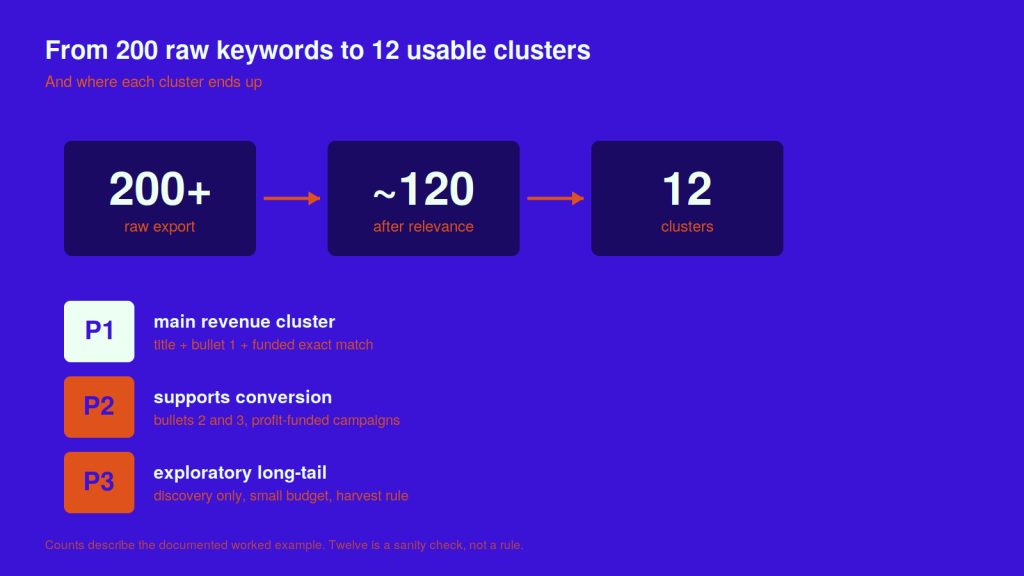
The priorities are the point. A cluster set without them is a taxonomy; with them it is a plan.
Priorities, and What They Are For
Each cluster gets a priority, and the priority determines what happens to it downstream.
P1 is the main revenue cluster. It earns the title, the first bullet and the best-funded exact-match campaigns.
P2 clusters support conversion rather than driving discovery. They belong in bullets two and three, and in campaigns funded to be profitable rather than to grow.
P3 is exploratory long-tail. It belongs in discovery campaigns with small budgets and a harvest rule, and most of it will never be promoted. That is the correct outcome, not a failure.
The point of the labels is that they force a decision about where each cluster’s money and copy go. A cluster set without priorities is a taxonomy. With them it is a plan.
Where the Clusters Actually Get Used
Two places, and they should agree with each other.
In the listing, the P1 cluster supplies the title, which is why a well-clustered set produces something like “Wireless Earbuds for iPhone – Noise Cancelling, 30H Playtime, USB-C Charging” rather than a keyword pile. Bullet one carries core features from P1, bullet two carries a use case from P2, bullet three carries an attribute.
In advertising, each cluster becomes an ad group. This is where clustering pays for itself most directly, because an ad group containing one intent can be bid on coherently. An ad group containing three intents produces an average ACoS that describes none of them and gives you nothing to act on.
What It Produced
One documented run is worth more than the theory. Starting from 200-plus raw keywords, filtered to 120, grouped into 12 clusters and applied to both listing and campaign structure, after 60 days: organic rank improved on 8 of the 12 clusters, PPC ACoS fell from 35% to 22% on better targeting, and conversion rate rose 18%.
Note which number moved most. The ACoS improvement came from targeting precision, not from bidding differently, which is the mechanism the whole exercise is built on. Note also that four of twelve clusters did not improve. A method that moved everything would be a method that measured nothing.
The Reason It Survives Algorithm Changes
Search on a marketplace is a relevance gate followed by a commercial ranking. Clustering improves the first half structurally rather than tactically, because it makes each surface of your listing unambiguously about one thing.
That is why the approach outlasts specific algorithm updates in a way that keyword-density tactics do not. The classification systems mentioned at the top are the proof of concept. The Census Bureau’s guidance on NAICS describes a system that deliberately groups businesses by production method rather than by product name, and it has survived repeated revision since it replaced the older SIC codes. The International Trade Administration’s account of Harmonized System codes describes the same durability in the customs world, with the World Customs Organization updating the six-digit standard every five years while the structure holds.
Both last because the hierarchy encodes something true about how the things being classified actually differ, rather than something true about how a particular database was indexed in a particular year. A keyword cluster set built on intent has the same property. One built on shared vocabulary does not.
Take your existing keyword list and try to write, for each group, the one sentence describing what that buyer wants. Any group where you cannot write the sentence is not a cluster. It is a pile of words that happen to rhyme.